|
 |
|
What to do when you can't fly.

NEW - 2007 Canvas Duzi
World White Water Champs
Subject: Nile river kayak trip 12/12/04

> Click on the rivers for more adventures.
Many of these photos are taken from various rivers I have paddled around the world, from our wild local rivers to Australia, Tanzania, New Zealand and the large volume Zambezi, and the jungle clad Central African rivers.
For many years kayaking, canooing and surfski paddling was my top sporting priority where I devoted much of my time to tripping various rivers. This lifestyle suited me quite well at the time as I was running commercial rafting tours and when between tours much time was spent with well-known top paddlers Nigel Briggs (my brother), Tim Biggs and Bruce Yelland travelling around the country looking for rain!
|
Below Howick Falls |
 Ndedema Gorge - Cathedral Peak |
|
Deepdale Falls |
  Tugela Falls Colenso South Africa |
 Buffalo River South Africa |
 Deepdale Falls Umkomaas River Natal South Africa |
 Augrabies Gorge 
Rafting Tugela River - South Africa |
Glacier Rafting |
 Rafting -New Zealand |
 North Island -New Zealand |
 Zambezi - Zimbabwe |
 Zambezi River Zimbabwe |
 Thrombosis Gorge South Africa |
 Congo River Zaire |


>>>>>>>>> Subject:
Nile river kayak trip 12/12/04 >>>>>>>>>>>>TOP
|
NILE RIVER OVER 6500 KM LONG. IT IS THE LONGEST RIVER IN THE WORLD
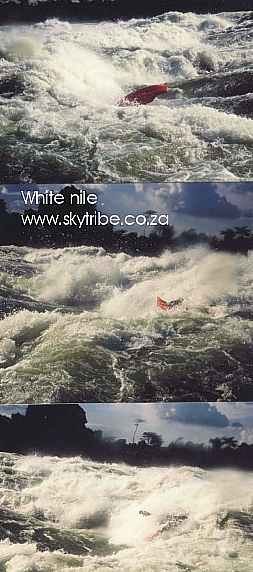
BELOW LAKE VICTORIA IS A HYDROELECTRIC STATION, THUS THE RIVER WILL RISE AND FALL AS MUCH AS A FOOT ON HEIGHT AS FAR DOWN RIVER AS 60 KILOMETRE'S, THUS DRASTICALLY CHANGING RAPID SIZE AND DYNAMICS. For some time now I have been meaning to get up to the Nile in Uganda to paddle some of the best white water in the world, so when a good mate of mine Berndt Kharmann come over to visit, it was simply a matter of booking the quickest flight into central Africa with our kayaks in tow. Having to route via Nairobi to Entebbe it was inevitable our kayaks would at best be temporally lost, only arriving 5 hours later in the early hours of the morning. Negotiating a flat fee for the hundred and forty or so kilometres ride to Ginj, we embarked on a journey of hell in the early hours of the morning in a taxi that seemingly was attempting to terminate his, alongside with our existences. Why more people do not die on these roads, I have no idea. The locals would overtake on blind rises, in low gear, would rampage through towns with the only warning of a hooter that we were approaching, and would have no concern of the potholes, cows and other oddments found on route. This turned out to be far more hazardous than the crocs, hippos and large holes and waves that are found on various sections of the Nile. Anyway in the early hours of the morning we found Nile river Explorers, pitched our tents and awake the next day looking down onto what must be one of the most fascinating rivers in the world. At this stage we were probably only six or so kilometres below the source at Lk Victoria, yet the river is massive, breaking into many channels and disappearing between various islands, with fairly easy class three on one side and class six plus on the other. Even on the Zambezi river I have not seen holes the size and power that occurred here, however because of the immense size of the river there is usually an alternative route past them.
In between rapids one finds pools with fishermen paddling around in their dugouts, sometimes crossing not far above some of the rather more treacherous rapids. With no life vests on, they would face certain death should they capsize here. They are in fact incredibly humble and pleasant people to be around, and since Idi Amin in the late seventies decided that in order for his stay on earth to be prolonged, he must relinquish power and exile himself to Saudi Arabia, his country has been fairly stable with new industries, businesses and entrepeneurs starting to flourish. Early on in the trip my paddling partner became caught in a rather large hole in the river and spent a minute or so being tumbled, cartwheeled and generally thrashed about. The end result was his plastic kayak looked a bit like a simba chip with a hole through it. Unfortunately he also damaged his leg resulting in a thrombosis in one of the veins, which apart from being extremely painful, can be life threatening is the clot continues to move or enters the deep veins of the leg.(in other words the clot may end up in a vital organ such as the heart, lungs or brain).
What did amaze me however was the calibre of the local black Ugandan guides and kayakers. Some of these guys have only been paddling between 2 and 6 years with one of them now rated 20th in the world in the free style kayaking discipline. They commenced their kayaking career with no sponsorship and achieved this level of competency through sheer hard work, perseverance and determination. Lets briefly look at South Africa's affirmative action policy. For many years now we have been ploughing funds into the upraisement of the previously disadvantaged. A percentage of all canoe race entry fees is distributed to valley trusts, schools etc etc. The South African canoe federation donates funds in order for young black paddlers to hopefully enter the competitive world of canoeing. Now ten years in democracy, a lot of money and time and effort, yet we still do not have a world class affirmative paddler??(and they still rob us throw rocks at our paddlers). I personally think our policy is wrong. I am not averse to the furtherment of disadvantaged sportsman, but for heavens sake money doesn't grow on trees, and the upliftment policy surely is not simply to create an environment where poor little black children can now simply have fun with our funds, with little or no incentives. Target those that have the potential, give them the facilities needed for success and then create targets, deadlines and goals. If after a reasonable period of time these are not met, them terminate the funding and move onto another disadvantaged paddler that WANTS to succeed and not simply to have their entry fees, boats and whatever else s subsidised. A lot of this money does originate in one way or the other from each paddlers contribution to various events, registrations etc, so surely they should have some say how their money is spent? It just seems to me that lots of money and support have been flowing into a system that has the right motives but unfortunately not the right control, goals and management. (anyway that was just my thoughts after seeing what was possible in a country where no goverment or sporting funding was available, yet now boasts affirmative paddlers that are so far ahead of even most of our white competitors. Read it objectively in the context that it was written and not subjectively as a stunted dysfunctional liberal, who's only train of thought in life is pouring unlimited funds into a system that if left unchecked will absorb everything and anything of value, with absolutely no return on the investment.
The commercial rafting section on the nile is a stretch of river around thirty kilometers long which is really not too bad. All one needs is a good roll and directional control in a plastic boat. From the end of this section at a rapid called Itanga, which means place of danger (as the rapid splits into 3 channels. The far left it drops over a shootable water fall called Gala gala falls. (at high water there is a massive hole at the base, and probably worth while staying away from). The centre channel drops into big, big holes and the right channel is paddlable from the top, however safer from half way down. (there are still three big holes at the end, but usually their main stream will wash you past them). From here down to a really nice rustic camp called the 'Hairy lemon' is about fifteen kilometers and great easy paddling and surfing. About three hundred meters up stream from the camp is a wave called the Nile special, which as long as you have a short boat, will provide unprecidented wave surfing anywhere in the world. Five kilometers down stream from here (flat water all the way), one comes apon another world class surfing wave called Malalu (again only usable on the short boats). Very few kayakers now still paddle long boats such as the dancer, T canyon and other boats older than the era of these. They just are not conducive to stunt paddling and steep wave surfing). I found this out when I arrived with a sponsored boat from some time ago and subsequently spent most of my time upside down, with the nose continously digging in, resulting in involuntary endos and cartwheels). |

 CONSISTS
OF THE WHITE NILE. SOURCE IS LAKE VICTORIA- UGANDA. THIS LAKE
IS SO HUGE IT HAS ITS OWN TIDE. HOME OF THE MASSIVE NILE PERCH
WHICH GROWS TO OVER 250 KGS IN WEIGHT. BLUE NILE. SOURCE IS
ETHIOPIA AND JOINS THE WHITE NILE AT KHARTOUM.
CONSISTS
OF THE WHITE NILE. SOURCE IS LAKE VICTORIA- UGANDA. THIS LAKE
IS SO HUGE IT HAS ITS OWN TIDE. HOME OF THE MASSIVE NILE PERCH
WHICH GROWS TO OVER 250 KGS IN WEIGHT. BLUE NILE. SOURCE IS
ETHIOPIA AND JOINS THE WHITE NILE AT KHARTOUM.


>>>>>>>>> Subject:
The Zambesi >>>>>>>>>>>>>>>>>>>>>>>>>>>TOP
|
|
|||||||||||||||||||
|
Lets stay on the topic of animals, where I will now describe a very close encounter with one of those prehistoric grotesquely hideous beasts-a crocodile. Having just finished canoeing the lower section of the Zambezi (One of the biggest rivers in the world), a friend and I were paddling a section of the river above Victoria falls (one of the seven natural wonders of the world). The Zambezi is an incredible river that passes through five countries on it's way to the sea at Chinde in Mozambique. At night we would camp on the riverbank with elephant and lion in extremely close proximity and awake in the morning with hippopotamus and crocodile spoor through the camp. The former animal is apparently responsible for more deaths in Africa than any other. They do not eat meat and are incredibly territorial and vicious when young are around. One of my friends has had his open type canoe bitten in half by a hippo while another has been rolled over a couple of times by a croc that had taken hold of the rear of his kayak.
My partner Rob Bentley, paddling in the same boat with me this time, pointed out one such creature on the bank, and mentioned it had entered the water. A few seconds later it was still proceeding at us, a visible bow wave ahead of it as it made a bee line straight towards us. As this section of the river happened to be fairly calm, we were paddling a fibreglass canoe, as it is more streamline and faster as opposed to the more robust plastic type designed for larger white water, which certainly perturbed me as it meant it would sink, resulting with us swimming to the shore if this croc attacked. This would undoubtedly attract more crocs and more likely than not we would have been eaten. As this croc reached a few feet from us I took an all mighty swing with my paddle at it's prehistoric scaly head, missed and sliced the water in stead, throwing us both off balance. The momentum of my blow took the racing canoe virtually over onto the upper deck and if it wasn't for the splash covers keeping the water out and the quick balancing of Rob to right us again, we probably would have landed on the creature. The commotion must have momentarily confused it's archaic intelligence, as it now seemed content to simply eye us out as we retreated with a dash of speed.
|
|||||||||||||||||||
 |
|||||||||||||||||||
|
BRIEF SYNOPSIS OF
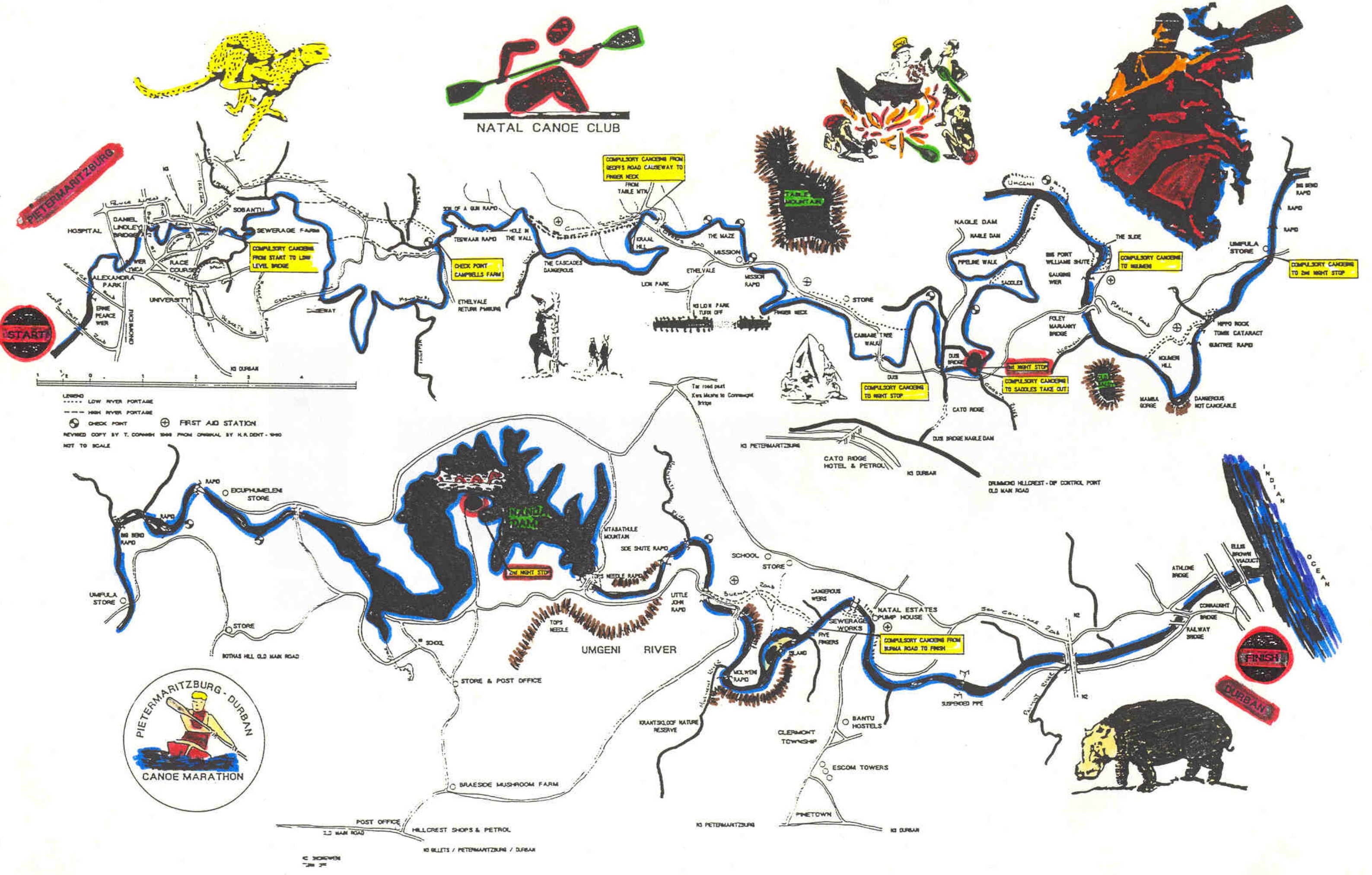
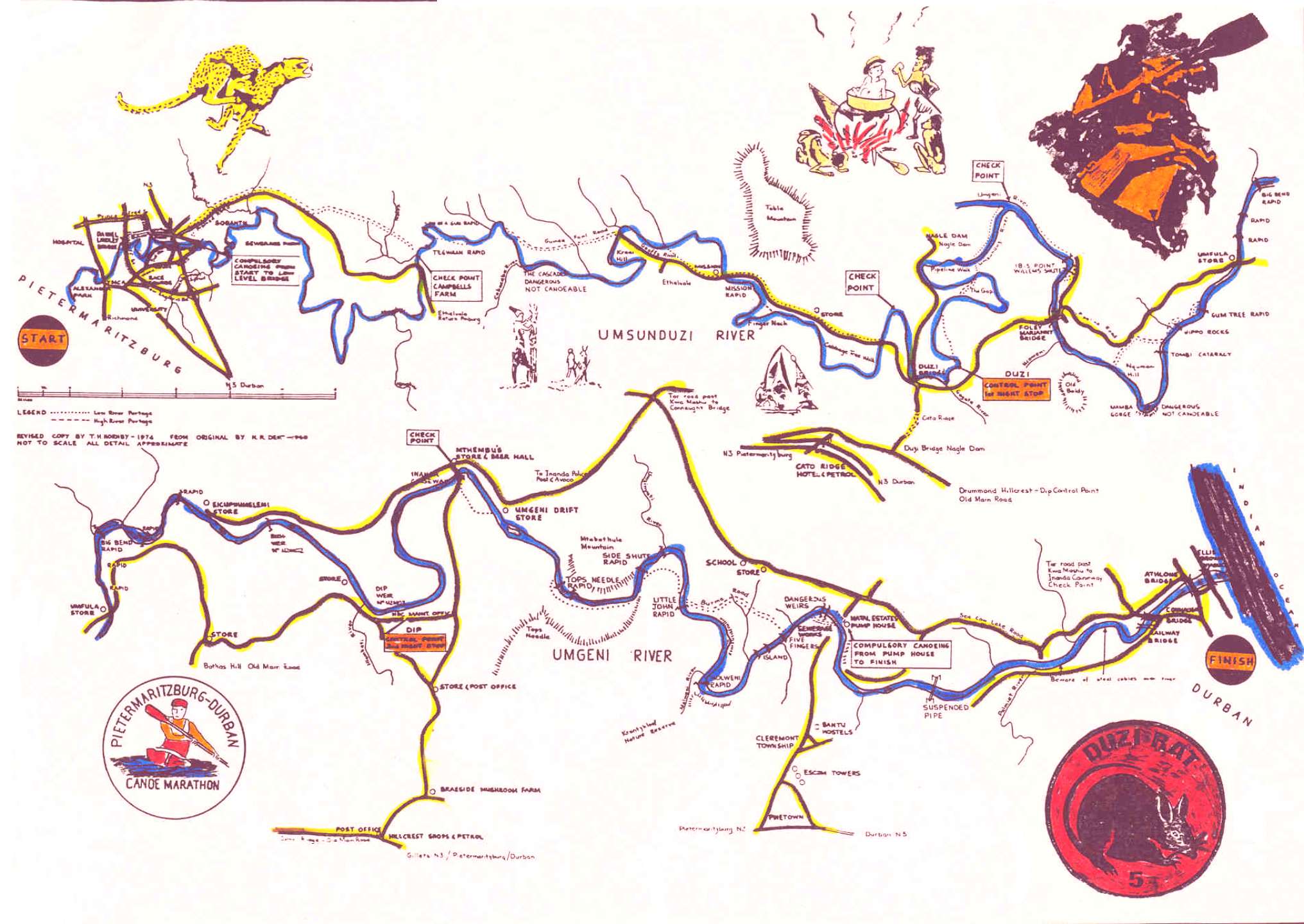
THE DUZI CANOE MARATHON AND HOW IT HAS CHANGED OVER TIME |
|||||||||||||||||||
|
THE START
 |
|||||||||||||||||||
| An earlier start of a Duzi during the early eighties
during my junior years. I'm second from the left. |
The start of the 1985 Duzi in Alexandra park. From the right to left. Dave and Nigel Briggs, Mike Tocknel and Keith Elleker, Tim Cornish and far left is Brian Cordes and Andrew Venter. | ||||||||||||||||||
|
The Duzi (a 3 day 120km endurance paddling and
running race between 2 major cities in South Africa namely Pietermaritzburg
and Durban) has always been a very special race for me. It takes
the competotors into some of the most hostile, rural and isolated
valleys in the country. The race begins on the Umzinduzi river
which means in "the river that pushes" which it certainly
does in flood. It then joins the Umgeni river at the slightly
upstream from the slide and ibis point. This latter river comes
out of the Nagle dam and is a great suppliment to the water
level when they are releasing. Back in the 1970s when my brother,
Nigel Briggs first raced the event, logistics, support and boats
etc wre very different from today. I remember accompanying my
mother who used to religiously follow him down stream to the
seconding points. This was before the Inanda Dam was even thought
about and all roads were mud and dirt, which became a logistical
nightmare when it rained. For those that are familiar with the
road out of the valley from the second overnight stop, imagine
it half the size and solid mud and water after heavy rains,
and imagine the difficulty in negotiating this obstacle in an
old VW!
|
|||||||||||||||||||
 |
 |
||||||||||||||||||
 |
 |
||||||||||||||||||
 |
Women in those days were not aloud to compete and in fact no woman seconder or otherwise were allowed to reside overnight in the valley and no competitor was allowed to exit the overnight stop either. This meant every female seconder had to vacate the valley before dark. Years later in 1981, this changed with women being allowed to compete only while accompanied by a male in a double and then eventually on to singles. This still was nothing compared to pioneers such as Ian Player, who back in 1951 raced non-stop sometimes through the night taking up to 6 days to reach Durban, having to carry all food, repair gear and everything else in their boat and having been bitten by a snake on the way. |
||||||||||||||||||
|
As the years progressed boats became lighter and more paddlers became target practice for bored, militant black youths, hell bent on the irradication of this white alien invasion of their sacred turf. My brother introduced me to paddling at a very young age when I remember trying to balance on his KI called a Lancer which he made at home in his garage. This he gave to me when I turned 13 or 14. At the time this was quite a state-of-the-art canoe and much more unstable and streamlined than the lymphies and wider hull boats popular and in use at the time. |
|||||||||||||||||||
 |
 |
||||||||||||||||||
|
I paddled my first Duzi 2 months after my 16th
birthday with a 16,5 kg single called a Sabre and managed to
win the schoolboy prize placing me 11th. In those days the start
was in the narrow river in Alexandra Park as Camps Drift and
the Fish Weir (Ernie Pierce Weir) was absent however still took
the competitors over Commercial Road weir which before and even
after the shoot or slide was made had seen it's fair share of
broken boats ending many an inspiring competitors end to the
race amere 100m down from the start. Most competitors exited
the river on the 1st day at Low Level Bridge and ran the 5 mile
portage to Cambells Farm. Nowadats everyone paddles past (due
primarily to Sabantu township and the opening up of this section
of the river which was very congested with overhanging trees,
vegetation and numerous tree blocks.) The 2nd day has been much
the same down to the Guaging Weir just above Mariani Folley,
which was not in existence and then of course the Inanda Dam
was absent making the 2nd overnight stop at Dip Tank Weir. From
here the river wound it's way throgh a few channels and sand
banks to Khumalos Causeway (not to be confuse with Khumalos
Store on day 2) and then into Top and Needles. Ealier routes
saw competitors on day 2 take out below the 2nd saddle and run
over the mountain and down directly to Mariani Folley through
the dry river course. In latter years when this was outlawed,
competitors used to some times run the entire section on the
right of the maize on day 1 crossing over to Finger Neck and
Cabbage Tree where they carried on running. Some used to also
run the section on River left from the Gum Tree (not Gum Tree
Rapid which is below Ngumenies) on day 2 sometimes all the way
to Ngumenies and then on below Ngumenies on the left bank to
below Hippo Rocks. Mamba Gorge which one misses due to Ngumenies
Portage still provides great plastic boating when the river
is full. Just a word of warning is to make sure that one takes
the channel around the main Mamba drop as at high water there
is a suck back from 10m downstream back into the drop. There
are a few syphons that can be missed but overall it is a great
short and exciting run. The walk back up to the top to Ngumenies
is probably the most strenuous part of the exercise. A few causeways
and road crossing have been added and subtracted over the years
as has occured on most of the days. The 3rd day commenced with
a winding river and sand banks all the way through which is
today the dam and the dam wall. This continued straight into
Tops and Needles where the river changed course slightly in
areas such as Five Fingers, Umzinyathi and Dogs Leg after every
large flood.
|
|||||||||||||||||||
 THE DUZI ROUTE AFTER THE DAM WAS COMPLETED. |
|||||||||||||||||||
 |
This picture was taken on one of our trips before the dam was built showing the advantages of Kevlar. It simply bends around a rock and once extracted may be straightned out again. One just has to make sure you are not in the boat when it bends. | ||||||||||||||||||
|
Umzinyathi named after the side river that enters the Umgeni from the left seems to have migrated downstream. Earlir the rapid just above the tributary was always known by this name however nowadays it is the longish, more open rapid downstream which seems to be called Umzinyathi. (It is also easier for spectators to access and view the paddlers). There was also no road winding along the side of the river downstream from the dam wall as found today. Island rapid has always been fairly high on most people's agenda to avoid. In the early days there was no old causeway at the 2nd drop and no pipes and rubble in the 1st drop but just big waves and a largish hole at the end of isle 2. |
|||||||||||||||||||
 |
These obstacles and old pipes were nearly responsible for Donald Bentley and myself prematuraly departing this world one Duzi in the early 90s when our boat dived into a wave, became stuck headlong in the mainstream of island 1. It never broke and just lodged itself there with bits of it barely visible with each surge of the river. This is the only time up til now we have ever not completed the race and a dissapointing end to 3 days with a boat still complete and very much in one piece but unable to be extricated. If exiting the boat and swimming downstream our splash cover or accessories had become caught on the oddments and bits and pieces lying below the surface, we would undoubtably be alongside our boat viewing the river bed, and still be there. | ||||||||||||||||||
 |
The channels into Durban were also quite different with the river taking a different course from today. The old channel can still be seen joining the mainstream just above the pedestrian bridge at Springfield Park. Blue Lagoon used to have the famous Swan boat that was regularly taking tourists on joy rides with the end being right at the mouth and not upstream as it is today. Interesting today are all the fetivities associated with the Duzi overnight stops. Fireworks, bands etc. I remember in the 70s when cut-off times really didn't exist and many evenings flares were discharged for those paddlers that were still missing, in the hope it would direct them towards the camp site. |
||||||||||||||||||
  |
  |
||||||||||||||||||
| This year 2005 was also a very special race as it was my brother's 30th race and my 18th and my 1st racewere I had to carry crutches into the boat for use on various portages due to a flying accident that happened 3 years ago which left me without the ability to run or walk properly. All credit to Nigel for carrying the boat down the hills while I brought up the rear. It was also our 5th race together with our best being a 3rd double position.back in the mid 80s. Green or permanent numbers are awarded as one reaches your 10th Duzi and the number depicts what number paddler you are to reach 10th race. For example, Nigel's 48 means he was the 48th person to ever complete 10 Duzi canoe marathons. The Duzi Rat stickers are awarded as one reaches the respective completion of each number of races. | |||||||||||||||||||
   |
|||||||||||||||||||
| Grand Canyon trip | More adventures here | |||||||||||||||||||
| CANVAS DUZI | |||||||||||||||||||
I wonder how many people are aware of the CANVAS DUZI which this year Dec 2007 has been running for 5 years. It mirrors the 1951 Duzi of Ian Palyers and also followers the same route as the non stop Duzi. This was initiated by Anton Venter who found some plans in a municipal library of how to build an exact replica of the early canvas and wooden canoes the early pioneers used. Wanting to complete 3 Duzis in a space of a month or so we (my brother and I) contacted Anton to find out if we could make, borrow or somehow acquire two single early canvas boats as we were quite keen to take part in this journey to Durban . ‘No problem' he said, ‘come on up and help fix two older ones I have in my store room' so off we trundled to Anton's farm outside Pietermaritzburg. Walking into his workshop I took one look at what resembled something fit for a lake and not the testing Duzi and questioned the feasibility of traveling 120kms in something with a canvas hull, wooden struts and a huge amount of flex. In his usual optimistic manner Anton reassured me of the strength, ‘Just don't touch too many rocks and you should be fine' he laughed. I wasn't too sure of this undertaking, this unnecessary epic and potential four day hell, but having committed myself to paddling alongside my brother it was signed and sealed. Having stripped the canvass of one of them all what was left was a skeleton resembling the gutted carcass of some disguarded and never to be a resurrected paddle boat. We replaced the wooden struts with screws and new canvass was attached with the same and bitumen paste. The other boat we simple patched with gemken and also bitumen while the broken struts where unscrewed and also replaced. I still wasn't too convinced of the possibility of bouncing off rocks as one would in the conventional fiberglass canoes but resolved myself to give it a shot anyway. Well D day arrived and on the 27 Dec 2007. Ten of us gathered in Alexander park in Pietermaritzburg. The start replicated that of 1951 which is just above the footbridge across the UmzinDuzi river. This is below Camps drift but above the old start used in the 80s. Certain rules were enforced and that entailed karki regalia, (shirts, hats etc etc), conventional paddles (no wings), no splash covers and no abandoning those in need. Cigarette stops were allowed and almost compulsory as were any other reason required for a rest!.
Still not believing the feasibility of these crafts we headed downstream towards commercial road weir which claimed the first casualty (I knew it I thought, this is madness). Anyway a quick repair job done and off we continued. We were truly blessed with more than sufficient water and we bobbed on heading south. Looking at the hull after every rock we slid off expecting to see massive gashes in the canvas and flooding water into the boat I was pleasantly surprised to see no such thing. A quick rescue mission of one of the boats below taxi rapid was undertaken to extract a boat that had bent around and obstacle and which was still paddlable really surprised me of the strength and robustness of these crafts.
On we went passing the flat rock take out where we vacated the river for the gum tree take out. Portaging was a new experience where paddlers pair off in twos and hook the noses onto a harness on either side of them and the same at the back. Over cambells we joined the road down to the put in above Tegwaan. Everything else turned out surprisingly well on day one apart from the atrocious pollution and rubbish we witnessed along the river course. Down to the Cambells take out I have never in my entire life witnessed such rubbish many metres about the water lever indicating the height of the river a week or so ago. Paddling these olden day crafts was quite interesting as they do not have any rudders or splash covers and directional control is achieved by paddles only.
Day one ended at yellow rock where we were met the efficient seconds once again and were ferried off to Inanda dam. I couldn't believe the organization Anton and his seconds had undertaken. Tents were up, snacks were available and beers were cold. I have never ever seen such professionalism in a sporting event in my entire life. How they and Anton managed all of this, two cooked meals a day, the use of the boats, petrol and transport all for a nominal few hundred rand.
I think many of the mainstream sporting organizers could learn a thing or two from this event. As this was a replica of the early days no woman competitors were allowed to participate or to stay over at the camp as it was in the early era. This may be open to change I believe as there has been a request that a woman paddlers would like to undertake this journey next year. In fact the Duzi only allowed female competitors in 1985 to compete as long as they were accompanied by a male counterpart.
Day two we were driven back to yellow rock were we portaged over the road and joined the river a kilometer or so above the saddles and paddled on down passed this to the take for the dry water course portage that joins the road down to Marriany Foley. Here onto Ngumenies where I experienced the new portage around Mamba gorge (refer to the photo of the mamba gorge drop). Once again at the top the ever enthusiastic seconds met us with lunch again and a compulsory smoke break and Anton's home grown chicken.
The usual mishaps occurred, patching and bailing but all but one boat made it to the dam again where we stopped once again for a magnificent hamburger cooked by the seconds on the river bank). Just after the bridge marking the beginning of the dam on the left hand side (about the third spur downstream) we took out again for coolie bus hill portage (as is done on the non stop Duzi). This looks surprisingly easy but soon turns into a long never ending haul upwards and then down to the dam on the other side. From here a bit of a pull onto our camp once again and that never ending supply of beers!
The usual repairs were again entered into with Anton as enthusiastic as ever, chopping wood out, replacing struts, rebuilding wooden stabilizers and cutting canvass patches.
That night some bright spark presented this drinking game that involved pushing a plastic crocodile hook and if it so happened to snap shut, you of course had to down some revolting, nauseating and potentially lethal concoction that I think Boerie had bribed the local witchdoctor for.
In the end I just drank it when it came my turn anyway as those damn jaws kept falling shut on my fingers. I think there was however more than meets the eye with this game but haven't quite put my fingers on it yet but involved something around the word ‘conspiracy'.
Day three was a short day down to where the Molweni River (From Kloof gorge) joins the Umgeni and apart from me snapping a paddle it was very pleasant and enjoyable day. Oh yes we has a small epic when the seconds threw a replacement paddle off the bridge below the dam wall for us and it proceeded to become recycled in the whirlpool below the dam. Nigel and I walked back to jumped into the pool below whereupon the paddle promptly was swept onto the other bank.
I was absolutely amazed at the strength of the rip circling back in the pool on river right below the dam wall. One simply cannot swim against it and it is a river on its own making circles. A short day and back to relaxing at the dam and some more magnificent food.
The fourth day we commenced. We left off and although the river was low we ambled on round Burma , through all the major rapids, side chute, little john and through five fingers. It was interesting to witness the progress of the Waterfall extension road that will take the congestion from Crest Holm and Hillcrest directly onto the sea at Durban via this route.
|
|||||||||||||||||||
| All in all it was a wonderful four days on this river. With such a relaxed pace, great companions and such well organized logistics, food and everything else it was a pleasure to undertake the canvas Duzi. | |||||||||||||||||||
|
|||||||||||||||||||


 On
one of my expeditions I came within a few metres of paddling
into a hippo, mistaking it for a rock in the middle of the river,
and let me tell you, these monsters that only ingest vegetation
are enormous, especially when they turn and look at you with
an open mouth and those small repugnant beady eyes. When they
disappear underwater and one loses sight of them, this is certainly
the time to retreat with great haste, as shortly it will be
attempting to eradicate you existence. It was with this in mind
that we kept an open eye on the riverbanks and pools. Most of
the crocs are lying on the banks and slide into the water as
one passes, however that is as far as they usually go.
On
one of my expeditions I came within a few metres of paddling
into a hippo, mistaking it for a rock in the middle of the river,
and let me tell you, these monsters that only ingest vegetation
are enormous, especially when they turn and look at you with
an open mouth and those small repugnant beady eyes. When they
disappear underwater and one loses sight of them, this is certainly
the time to retreat with great haste, as shortly it will be
attempting to eradicate you existence. It was with this in mind
that we kept an open eye on the riverbanks and pools. Most of
the crocs are lying on the banks and slide into the water as
one passes, however that is as far as they usually go. 


|
Quick Links
|
|
>
Take Off
|
 Zambezi River Zimbabwe |
"Avoiding danger is no safer in the long run than outright exposure. Life is either a daring adventure or nothing at all."
|
Featured
Product |
 Now on CD |
"You've never lived until you've almost died. For those who fight for it, life has meaning the protected will never know."
|
Featured
Product |
 Video CD |
"What
we think, or what we know, or what we believe, is in the end, of
little consequence. The only thing of consequence is what we do."
|
Zambezi River Zimbabwe |
"The thing with the road less taken - either it is the best ride of your life or it kills you."
 Waterfall on Congo River -Zaire |
|
Featured
Product |
|
Our 3 in 1 CD contains an
e-version of : |